Guy Vandromme (1968) is a pianist/conductor, artistic producer and curator, working within the fields of new music, opera and music theatre, dance and contemporary art. His main focus is reviewing the boundaries of new listening formats, collaborating and going into dialogue with contemporary artists, exploring scores of forgotten music and continuously searching for new transdisciplinary artforms.
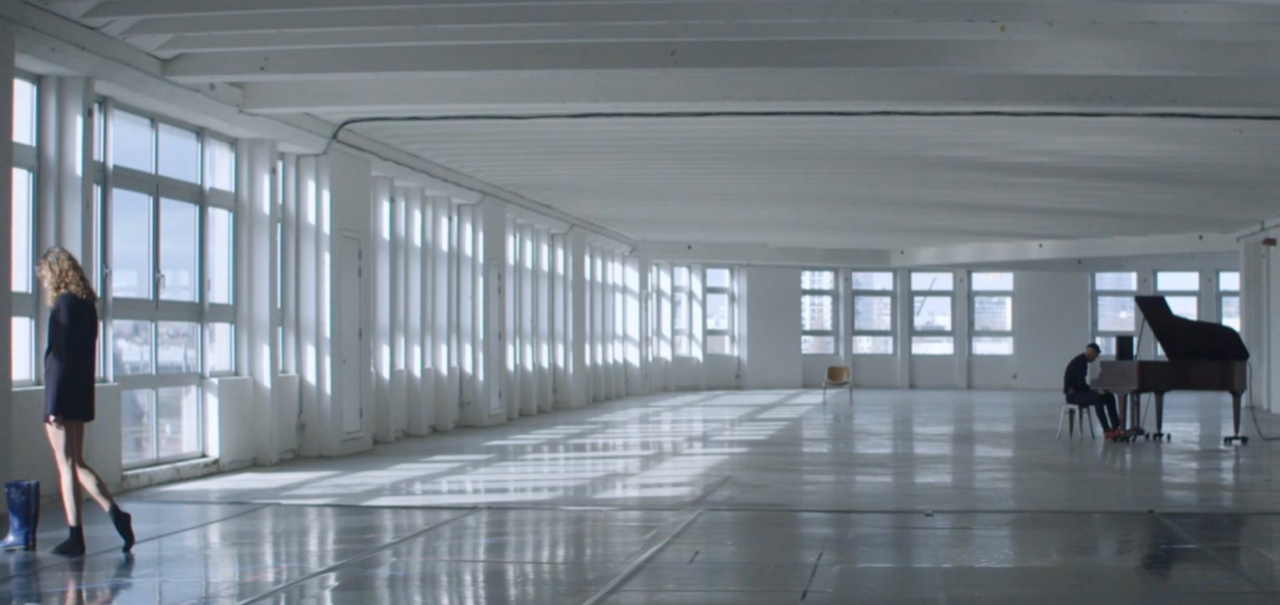
- © “Drei Choräle” – Film & choreography by Isabella Soupart, musical direction and piano by Guy Vandromme – Production Made in Bruxelles / ACT2 (2021)
After studying piano with Levente Kende and Heidi Hendrickx, he immersed himself in the perfection and performance of contemporary music and music theatre in the studio of La Monnaie in Brussels, Paris, Liège and Mons with, among others, Koen Kessels, Alain Franco, Jean-Pierre Peuvion, Philippe Pierlot, Geneviève Foccroulle, Henri Pousseur, Célestin Deliège, Ivo Venkov and Johan Schmidt.
A very important encounter and catalyst for his later creative process took place through the long term mentorship of conceptual artist Martin Maloney. His Split Space and Language art works formed the basis for Vandromme’s artistic development in which the change of sound starts much more from the choice of texture and material, rather than from a written codex.
Professionally active in the arts since the 1990’s Guy Vandromme was a co-founder of Q-O2 and the HERMESensembles, led the programming of the Klankfabriek and Klankenstroom festivals, was classical music programmer at deSingel and responsible for the classical music section during Bruges, European Capital of Culture 2002. Today he’s directing the Talklang festival in South Tyrol.
Next to his aim of presenting forgotten music of artists such as the inventor/composer George Antheil, the mathematician Herman Van San, the original setting of Les nuits d’été of Berlioz, the work of Stefan Wolpe and Erich Itor Kahn or the underestimated fabulous works of late renaissance composer Tobias Hume, more recently he was very much involved in collaboration with choreographers/dancers such as Raimund Hoghe, Isabella Soupart, Johanna Willig Rosenstein and Emma Ribbing where he is most of the time reviewing the role of the musical dramaturgy in works like Le Sacre, La Valse, Stretch Timemonochromes and Silence.
- Drei Choräle with Isabella Soupart, 2021
In addition to contemporary music, Vandromme’s activities focus on the performance of remarkable works for music theatre, on work with vocal and textual settings, on the dialogue between old and new music and on the sonic cartography worldwide in which he has collaborated with Luciana Elizondo, Frederik Donche, Koen Van Synghel, graindelavoix, Eric de Kuyper, Currende, Jan Van Outryve, Soetkin Baptist, Tom Hannes, Gijs Van der Linden, Joan La Barbara, Tore Denys, Marianne Van Kerckhoven, Arnout Malfliet, Maja Jantar, Henk Neven, Olalla Alemán and Mireille Capelle and Tom Hannes.
Based on a long collaboration with the Wandelweiser composers such as Jürg Frey, Antoine Beuger, Michael Pisaro-Liu, Eva-Maria Houben, he started editing CD’s at Wandelweiser Records with music of Herman van San, John Cage, Erik Satie and Carlo Inderhees.
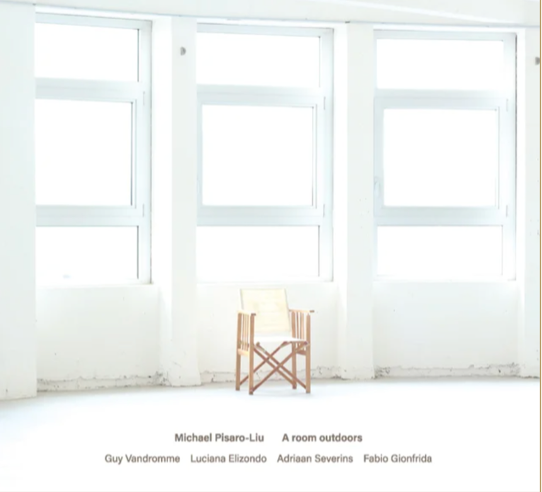
In 2023 he was invited by the NY based label Elsewhere Music to release A room outdoors by composer Michael Pisaro-Liu which was selected as one of the best field recordings by Bandcamp in 2023. In December 2024 a new album / vinyl called December with music of the American composer Craig Shepard will be released by Wadi, a close collaboration with sound designer Adriaan Severins and jazz trumpet player Sam Vloemans.
ACT2
In 2020 Guy Vandromme set up his organisation ACT2 – Cultural Platform and Cultural Development – during the pandemic to examine the full spectrum of music creation and music presentation through research on musical performance practice. Questions were asked about the definition of artistic experience, about the existing boundaries between performer, musical work and audience and about how the audience could be part of the creation process. In various places in the community, we investigated how music could enter into a more participatory dialogue with the audience, which formats could be used and whether certain composers have not already paved the way for this.
ACT2, which is gaining ground internationally this project (Festival of Flanders, Storm op Komst, Continuum during Slow(36u) in Bruges/Concertgebouw, the Klarafestival, Talklang in South Tyrol, Klangraum in Düsseldorf), has made various festivals and organisers enthusiastic about this re-sourcing and re-working of standard artistic formats. The niche that ACT2 is developing manifests itself within the field of the musical, sonorous experience to which a transdisciplinary touch is given and in which the audience completes, co-creates the composer’s creation.
This research always revolves around questions that transcend the ordinary classical performance. How are works performed and do they become part of a larger whole of the group present, the co-creator, is the whole perhaps part of an almost living installation? Where is the boundary between scenographic musical dramaturgy and visual and audiovisual representation? Can a philosophical or social comment be the impetus for an expression of new sonorous experiences and are we really forced to reduce and limit musical expression to only those who have learned to understand its classical and romantic codex? The boundaries become very vague, distort and completely new creative social dimensions emerge.
ACT2 started working with various co-creators: the freely moving audience at a SLOW festival, the young participants present at a youth arts festival, the audience during hours-long performance sessions at an art intervention or the audience, the musicians and composers present for several days at a Klangraum intervention in Germany. The method we use here is very simple: we invite everyone to discover the exciting world of open scores together. This is a form of music-making that focuses on collectively discovering the surrounding sonorous world of the co-creators or the environment via guidelines (a codex or legend) from a composer. We often link what can be described as jam sessions for young and old to what is present around us, we explore and get inspired by the power of acoustics, searching for the surprising sound world of nature or a world of silence.
As we do not improvise, the composer gives us a few rules for the game with which we get to work as performers and co-creators. The result will always be different, free but within the guidelines of these rules of the game, the musical codex of the composer. We collect and process this sonorous material which will form the basis of the moment of presentation, an artistic finality that is central to this practice. These public ‘in situ’ performances and the joint creations take the audience into a moment of stillness, a kind of timelapse with the aim of opening up our perception to deceleration, co-creation, reflecting on musical colours that arise at the moment, and above all to work together in search of a new anthropological form of community experience.
Find more info on his website, built by Bureau Doove.
