Part of the project Covers for the World is the decolonizing reinterpretation of Picasso’s Demoiselles d’Avignon. Pierre Mertens made an earlier version for the Biennial of East Africa with artists based in Europe. But for the version in Moshi Pierre thought it was important to fully hand over to local Tanzanian artists. One of the these is Lightness Jonas who, as a person with disabilities, has taken to painting with her feet.

Lightness, can you tell us how you started to work as an artist and what it means for you?
I’ve been drawing since I was very little. I started with stick figures, then moved to colored pencils. I remember my mom once helped me draw a hen. She’s not an artist, but we made it into a fun little game, talking in broken English and laughing together. That memory still warms my heart.
When I joined The School of St Jude in Arusha, I didn’t struggle with the drawing or English exams during the interview, it felt natural. At St Jude, my talent was nourished. I had access to art materials, clubs, and great mentorship.
No one ever formally taught me how to paint. I would observe closely and teach myself. I’ve always had a unique way of seeing colors I can somehow tell which colors were mixed to create another, even without being shown. It’s hard to explain, but it feels like I see beyond the surface.

In your very colorful work, there’s a lot of reference to local animals like elephants, giraffes, or zebras, but also to portraits of women. Why this choice of subject matter?
I love painting animals and women because they’re often viewed as weak or less valued but to me, they’re powerful, beautiful, and full of life. They make nature complete. My art is a way of showing that they, too, deserve attention, honor, and admiration.

Apart from painting with your feet, you also make use of new media such as AI to generate images that you then transfer to canvas which we also show in the exhibition. How did you start using AI as a way to generate visual work?
My imagination is really strong, sometimes it floods my mind with ideas. I realized that if I didn’t capture those ideas quickly, I’d forget them. AI became a tool to stabilize and store those visions.
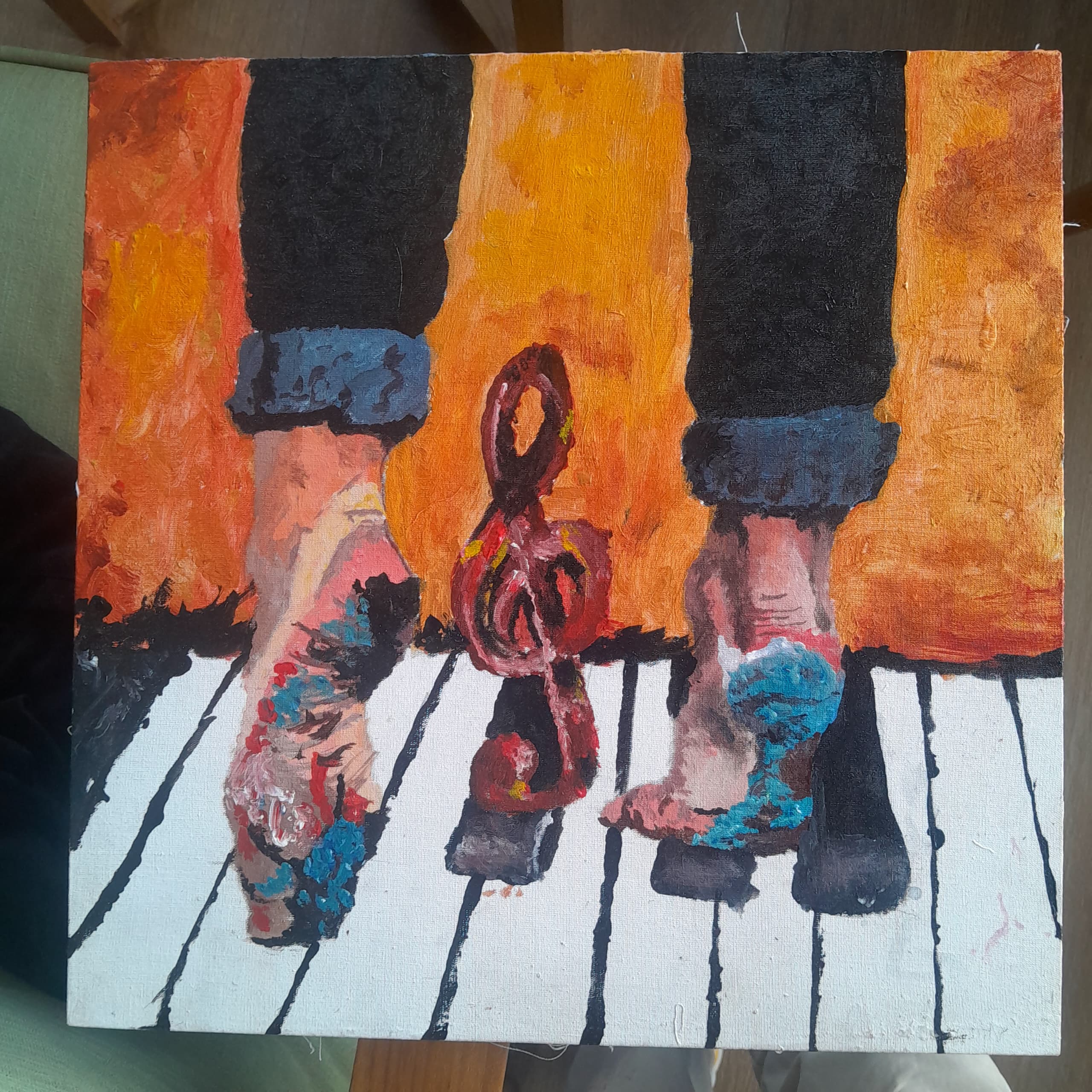

Many artists use references from Pinterest or artworks by others, which is okay, but I’ve always wanted to be unique. By using AI, I can create references from my own ideas —art that has never existed before. It also helps that I type really fast with my feet on the computer!
I’ve seen part of your reworking of the Demoiselles. Can you tell us a bit about what you are doing with it?
I’m reinterpreting Picasso’s Demoiselles through my own lens, adding my voice, identity, and imagination to it. I want to show that classic art can evolve and carry new meanings when seen through different eyes and experiences. It’s about transformation and bringing something fresh and deeply personal to the work.
I added patterns that look like African fabrics to link Africa with it.

What’s your dream as an artist?
I used to dream of becoming an architect, but recently I’ve realized that art fits me completely. My dream now is to use art to inspire change and bring people together. I see the different colors in my paintings as representing people with different histories — and I bring them together on one canvas to create something beautiful.
For more, view the Instagram and YouTube accounts of Lightness via the links.
Her work will be presented during the International Day of Persons with Disabilities on Wednesday, 3 December 2025, for the opening of SHARE, The Global Center for Accessible Care by Child-Help International at Moshi, Tanzania.

Leave a comment